

Take you to understand the performance and production process of PMI foam board
Release time:
2026-01-10 10:00
Performance of PMI foam board
Lightweight and high strength
Among foam materials of the same density, PMI foam is currently the rigid closed-cell foam material with the highest specific strength and specific stiffness. It is much lighter than traditional materials such as wood and metal, yet is nearly as strong as some aluminum alloys.
Waterproof and moisture proof
The pores of PMI foam are closed and isolated from each other. Since the foam is completely closed, it is difficult for moisture and water to penetrate into the sandwich layer.
High temperature resistance
The polymer chain of PMI foam has a complete imide ring structure and inter-chain cross-linking structure, which greatly improves the heat resistance and pressure resistance of the material, and the long-term use temperature can reach 180-250°C.
easy to glue
PMI foam has a highly polar molecular structure and a dense honeycomb surface state. During the co-curing molding process of composite sandwich materials, it can form good adhesion with various resins such as epoxy resin, bismaleimide resin and cyanate ester resin.
easy to process
PMI foam is easy to cut, slice, mill, etc. It can be processed into various special-shaped foam parts using CNC machine tools. In addition, foam sheets can be bent into various curved surfaces under heating conditions, thereby increasing the freedom of design and processing.
low dielectric properties
PMI foam has extremely low dielectric constant and dielectric loss, making it suitable for structures that need to emit and transmit microwaves.
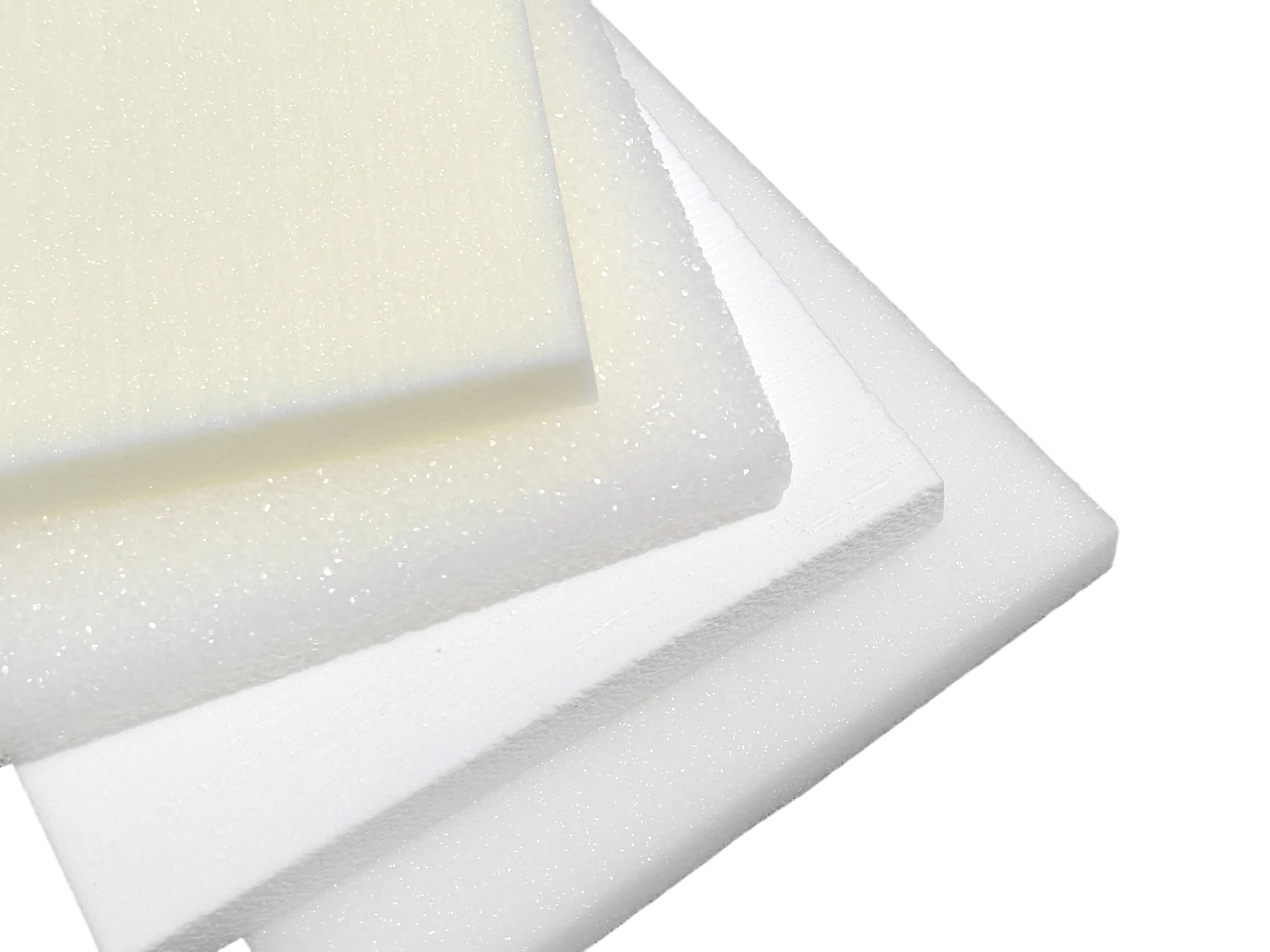
PMI foam is produced using a precisely controlled process:
1. Dosage and mix liquids.
2. Pour the mixture into the mold, put the mold into the water tank, and heat it through a water bath to foam and form a blank.
3. Put the blank into the oven for pretreatment and heating.
4. Transfer the blank to a high-precision oven for final foaming.
5. Return the blank to the oven for post-processing.
6. Finally, use a press to flatten and slice.
The entire production process adopts mechanized production and is combined with manual inspection to ensure stable product quality.
Next page
Next page

Add:Building 3, No. 91, Shipai Avenue West,Shipai Town, Dongguan City, Guangdong Province.GD523331, P. R. China
MR.Wei , Phone :+( 86 ) 137 1262 9500
Tel:+( 86 ) 0769-8137 2186
Mail:sales@keyuace.com